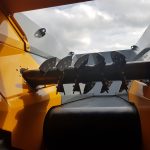
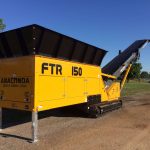
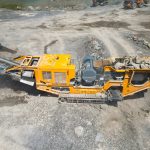
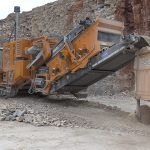
A Jaw Crusher is a piece of equipment that is typically used in the primary crushing phase to break down large feed material into smaller pieces so they can be processed further downstream. The Jaw Crusher is a versatile machine with the ability to adapt to a range of different applications depending on material hardness or abrasiveness. Jaw Crushers are suited to primary crushing due to the process used to break material. The material becomes trapped in the jaw die and material is crushed due to compression from the jaw plates.
How does a Jaw Crusher work?
The Jaw Crusher consists of a fixed jaw plate that is mounted within the crusher frame and a movable jaw plate which acts as the compressive force when the material enters the chamber.
- The two jaw plates are positioned in a ‘V’ shape where the material can fall into the gap as the space between the jaw plates decreases.
- The angle at which the jaw plates are positioned is known as the nip angle – this is a feature of the Anaconda J12 Jaw Crusher.
- To facilitate movement, the eccentric shaft passes through the top of the jaw plate. The eccentric shaft is attached to the toggle plate which can pivot- this allows the jaw plate to move back and forth. The back and forth motion leads to a compressive crushing action on the material in the jaw chamber.
- The pressure produced by the two jaw plates reduces the size of the material as it travels down until it reaches the bottom of the chamber where it can exit.
- The Closed Side Setting (CSS) is the gap between the fixed jaw plate and the moveable jaw plate. The Anaconda J12 Jaw Crusher’s CSS can be fully adjusted to meet the size specification required.
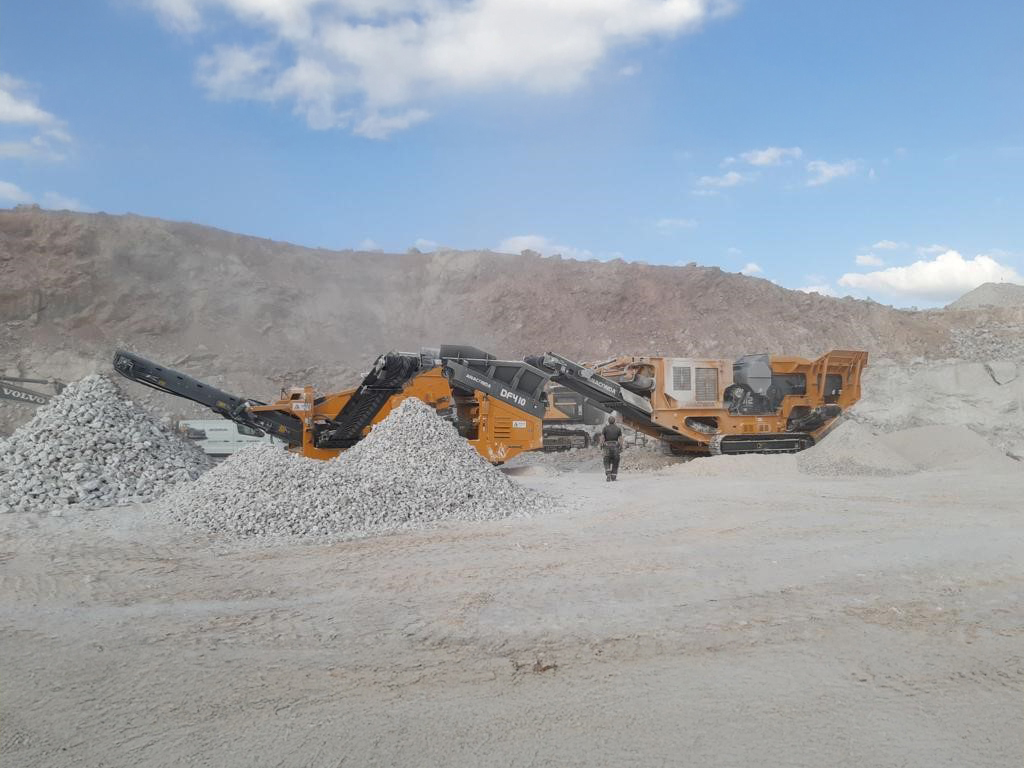
What materials can a Jaw Crusher process?
Jaw Crushers are known to be robust and suitable for primary crushing applications. They can process hard rock or basalt with ease and can also size softer materials such as limestone. The throughput will vary depending on the feed material and the required product size. The Jaw Crusher excels in waste recycling applications as it can easily accept feed material containing rebar. The Anaconda J12 Jaw Crusher can be fitted with an overband magnet to eliminate product contamination by removing steel fragments from the feed before it is sent for further downstream processing.
What applications suit a Jaw Crusher best?
Jaw Crushers are mostly used for primary crushing in quarries and mining applications for medium-hard aggregate and ore. As a primary crusher, the Jaw Crusher does not require the feed to be sized prior to entry into the crushing chamber, however the Jaw Crusher should be run at a lower speed with hard or abrasive materials to reduce wear on liners. The Anaconda J12 Jaw Crusher can operate as a standalone crusher or in tandem with a Scalping Screen to remove oversize material and ensure the final product is in-spec.
Benefits of using a Jaw Crusher
Jaw Crushers are versatile and can accept a wide range of materials. They are straightforward in operation and easy to maintain. Unlike secondary and tertiary crushers, the wear on the Jaw Crusher is minimal.
Jaw Crushers are designed to be able to achieve a high output. The wear parts in a Jaw Crusher include both the static/moving jaw plates and the cheek plates. The Anaconda J12 Jaw Crusher was developed to allow easy access to be able to change out wear parts easily, reducing downtime and maintenance windows.
Implementing a Jaw Crusher into your crushing application
Jaw Crushers are mostly used in the primary stage of any crushing application as they can deal with larger, abrasive feed material. In applications where a finer product is required additional crushing stages will be needed to further reduce the size of the end product. Secondary and tertiary crushers such as Cone Crushers and Impact Crushers can be used for additional processing. When a series of crushers and screens are used and the material is fed directly from one to another this is known as a ‘Crushing Train’ which can be configured to meet the operation’s product specification.
The quality of the infeed will vastly affect the discharge material. Correctly configuring the crushing train will ensure the process is optimised for the best results. Bulky feeds that have a high fines content may benefit from utilising a screen prior to primary crushing to remove fines before they enter the crushing chamber. This will prevent a buildup of fines material in the crushing chamber that can cause blockages and unnecessary wear on liners.
What to expect with product output
Jaw Crushers are compressive crushers that fracture along the natural planes of the material. Uniformity of shape or size is not the main purpose for a Jaw Crusher – they are designed to perform at a high crushing ratio to rapidly reduce the infeed material for further processing. At the secondary crushing stage, a Cone Crusher or Impact Crusher will focus on output quality. For example, Cone Crushers and Impact Crushers can produce a more cubical, uniform product.
Maintaining your Jaw Crusher to prolong wear life and performance
Like all equipment, it is important to maintain and service it regularly to keep it operating efficiently. All Anaconda equipment comes with a service schedule and recommended spare parts list. Keeping equipment maintained and operating as expected allows producers to focus on productivity instead of equipment reliability.
Regular Checks
- Review the equipment manual and perform all checks at the recommended intervals.
- Check the wear parts (jaw plates and cheek pieces) to ensure they are fit for purpose – uneven wear, cracking or excessive scalloping.
- Check the bolts on the jaw plates and cheek pieces to ensure they are secure.
- Check the size of material being produced to ensure CSS is set correctly.
- Do not replace jaw plates before they have reached their wear limit
General Operation
- Ensure the Jaw Crusher is continuously fed at a steady rate as this will help to push material further down into the jaw die.
- A varied feed size will help more material enter the jaw and ensure an even wear on the jaw plates.
- Use a vibrating grizzly to scalp fines off feed material before entering the jaw.
- Check bearings and toggle points are properly greased and top up if necessary.
- Check oil and lubricant levels as per the equipment manual and replenish as necessary.
Cleaning
- Remove any obstacles from around the Jaw Crusher and any built-up debris on the unit itself.
- Clean out breather filters and install new oil filters as per the service schedule.
- Assess all seals for damage and replace if needed.